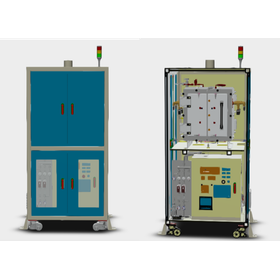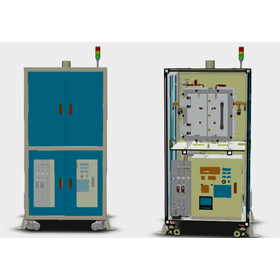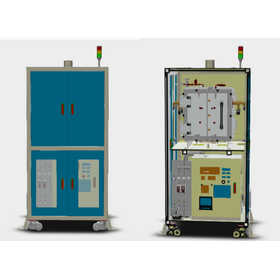
We have compiled a list of manufacturers, distributors, product information, reference prices, and rankings for Chlorine furnace.
ipros is IPROS GMS IPROS One of the largest technical database sites in Japan that collects information on.

Chlorine furnace - List of Manufacturers, Suppliers, Companies and Products | IPROS GMS

Chlorine furnace Product List

1~5 item / All 5 items

Displayed results

Small Chlorine Furnace 'Serialization' Starts

An easy-to-understand introduction to the background of the development of small chlorine generators, the specifications of the equipment, and operational points!

We will introduce the small chlorine furnace that our company handles in a series of articles covering: ■ Background of development ■ Impurity removal mechanism inside the chlorine furnace (chloride volatilization method) ■ Specifications and operational points of the equipment First, let's discuss "Why a chlorine furnace?" In recent years, with the miniaturization of semiconductors and the enhancement of battery performance, the management of metallic impurities (conductive foreign substances such as Fe/Cu/Ni) in powder raw materials has rapidly advanced to the ppm to ppb level. Even slight contamination can have a fatal impact on yield and reliability. Common countermeasures include: 1. Wet method (acid treatment): Dissolving and removing metallic impurities with strong acids. 2. Dry method (magnetic separation): Recovering magnetic particles with powerful electromagnets. However, ■ While the wet method has the advantage of uniform removal, it poses challenges such as large amounts of wastewater, unsuitability for water-sensitive materials, and energy burdens from re-drying. ■ Magnetic separation is limited to magnetic particles and is less effective for non-magnetic metal compounds and fine adherents. *For more detailed information, please download the materials or feel free to contact us.*

  • Industrial Furnace
  • Chlorine furnace

Added to bookmarks

Bookmarks list

Bookmark has been removed

Bookmarks list

You can't add any more bookmarks

By registering as a member, you can increase the number of bookmarks you can save and organize them with labels.

Free membership registration

Small chlorine furnace

Applied as a metal removal process or reaction control furnace that does not produce water-repellent products or large amounts of waste liquid!

The "Chlorine Furnace" is a device that accommodates halogen gases such as Cl2 and HCl gas, utilizing Thermonic's unique technology. (CE, SEMI, UL standard certification) By adopting shelf plate heaters, it enables uniform heating, allowing Cl2 gas to diffuse throughout the sample for highly efficient reactions. Additionally, it can lower the boiling point of the generated chlorides, enabling processing at lower temperatures. 【Features】 ■ Accommodates halogen gases such as Cl2 and HCl gas through unique technology ■ Enables uniform heating with the adoption of shelf plate heaters ■ Allows Cl2 gas to diffuse throughout the sample for highly efficient reactions ■ Can lower the boiling point of generated chlorides, enabling processing at lower temperatures ■ Reduces the risk of leakage of Cl2 and HCl gas *For more detailed information, please download the materials or feel free to contact us.

  • Industrial Furnace
  • Chlorine furnace

Added to bookmarks

Bookmarks list

Bookmark has been removed

Bookmarks list

You can't add any more bookmarks

By registering as a member, you can increase the number of bookmarks you can save and organize them with labels.

Free membership registration

Small Chlorine Furnace "Series Part 3": The Concept of "Safety" in Chlorine Furnaces

The essence of "managing risks" lies in design philosophy and operational design! Incorporating a sense of security in operations into the design.

In the previous session, we introduced the principle of removing metal impurities by converting them into chlorides in a chlorine furnace (chloride volatilization). Today, we will address a common concern: "Isn't it dangerous to flow corrosive and toxic gases like Cl2 and HCl at high temperatures?" Tubular furnaces are readily available, versatile, and suitable for the new synthesis of small sample sizes. However, there are undeniable "common issues" such as "a small effective heating area, which tends to limit scalability" and "the risk of micro-cracks in the tubes due to long-term use or thermal shock, increasing the risk of leaks during positive pressure operation." The equation "high temperature × corrosive gas = danger" is intuitively correct. That is why the essence lies in "managing risks" through design philosophy and operational design. The small chlorine furnace from Thermonik ENG is built with this concept in mind. Design philosophy for safety: 1) Based on negative pressure (reduced pressure) operation With a vacuum system in place, the internal pressure of the furnace is always maintained below atmospheric pressure. This suppresses any potential blowout in the event of seal degradation, thereby reducing the risk of Cl2/HCl leakage. *For more details, please download the PDF or feel free to contact us.

  • Industrial Furnace
  • Chlorine furnace

Added to bookmarks

Bookmarks list

Bookmark has been removed

Bookmarks list

You can't add any more bookmarks

By registering as a member, you can increase the number of bookmarks you can save and organize them with labels.

Free membership registration

Small Chlorine Furnace |Safely Treating Chlorine and Hydrogen Chloride

Achieved safe operation of chlorine and hydrogen chloride, which was difficult with conventional furnaces. High corrosion-resistant design for corrosive gas compatibility enables reproducible dry operation.

We handle a "small chlorine furnace" for research and development purposes. This device was developed to address issues such as the "high risk of gas leakage and poor safety" associated with tubular furnaces, as well as their unsuitability for sample scale-up and continuous testing. The furnace features a sealed structure that allows for the safe and highly controllable supply of chlorine and hydrogen chloride, enabling reproducible dry processing using corrosive gases at a research level while ensuring sufficient sample quantities. 【Features】 ■ High corrosion-resistant materials: Achieved through Thermonic's unique technology for high corrosion resistance. ■ Easy connection to scrubbers: Simple integration with liquid absorption and two-stage neutralization towers. ■ Compatible with corrosive gas monitoring: Can operate in conjunction with leakage detection sensors. ■ Scale adaptability: Capable of processing samples ranging from a few grams to several hundred grams. ■ Operates under constant negative pressure: By operating at a pressure lower than atmospheric pressure, the risk of process gas leakage is reduced. *For more detailed information, please download the materials or feel free to contact us.

  • Industrial Furnace
  • Chlorine furnace

Added to bookmarks

Bookmarks list

Bookmark has been removed

Bookmarks list

You can't add any more bookmarks

By registering as a member, you can increase the number of bookmarks you can save and organize them with labels.

Free membership registration

Small Chlorine Furnace |New Experimental Platform for High-Temperature Corrosion Evaluation

Utilizing the high corrosion-resistant structure and precise atmosphere control of small chlorine furnaces, applications for research on corrosion mechanisms of metals, alloys, and ceramics.

Our company offers a "chlorine furnace" that can reproduce corrosion behavior in chlorine and hydrogen chloride atmospheres. This experimental furnace safely reproduces high temperatures in corrosive environments. It is theoretically expected to be applied to fundamental research on high-temperature corrosion mechanisms caused by chlorine gas, durability evaluations of chlorine-resistant materials (high alloys, coatings, ceramics), and testing platforms for corrosion prevention coatings. We also provide test equipment. 【Features】 ■ Compatible with corrosive gases such as chlorine and hydrogen chloride ■ Simultaneous control of reduced pressure and temperature ■ High-purity atmosphere due to dry structure ■ Reduced risk of process gas leakage due to constant reduced pressure atmosphere *For more detailed information, please download the materials or feel free to contact us.

  • Industrial Furnace
  • Chlorine furnace

Added to bookmarks

Bookmarks list

Bookmark has been removed

Bookmarks list

You can't add any more bookmarks

By registering as a member, you can increase the number of bookmarks you can save and organize them with labels.

Free membership registration